To register a business in Kenya, create an account on the eCitizen portal at ecitizen.go.ke, navigate to the Business Registration Service (BRS), submit up to 3 proposed names, complete your registration details, pay the government fee (KES 950 for a business name or KES 10,650 for a private limited company), and download your certificate once approved — all done entirely online without visiting any government office. The entire process takes 1 to 7 working days depending on your business type and how complete your application is. Once your certificate is ready, register for a KRA PIN on the iTax portal, obtain your county Single Business Permit, and Sign up free on LeadsPro to start connecting with customers and leads for your new business immediately.
The landlord is asking for a registered business certificate before renewing your lease. The government tender you have been waiting for requires proof of registration. The bank account you want to open needs a Certificate of Incorporation. Learning how to register a business in Kenya used to mean weeks of queuing at Sheria House with folders of photocopied forms. That era ended. The Business Registration Service (BRS) moved fully online through the eCitizen platform, and in 2026 you can complete the entire process from your phone in Nakuru, Kisumu, or Mombasa without travelling to Nairobi at all.
Kenya has over 7.4 million MSMEs, according to KNBS survey data — yet only 1.56 million of those businesses are formally licensed, meaning millions of entrepreneurs are leaving legal protection, bank access, and government contracts on the table. This guide gives you the exact process, real 2026 fees, every document you need, and the mistakes that cause most applications to fail.
What Is Business Registration in Kenya?
Business registration in Kenya is the legal process of formally recognising your business under Kenyan law through the Business Registration Service (BRS), operated by the Attorney General’s Office. Once registered, your business becomes a legally distinct entity — able to open bank accounts, sign contracts, apply for tenders, and operate without regulatory risk.
Registration happens through the eCitizen portal and is governed by the Companies Act 2015 (for companies), the Registration of Business Names Act (for sole proprietorships and partnerships), and the Limited Liability Partnerships Act 2011. The type of structure you choose determines which law applies, what you pay, and what documents you need.
Business Registration Options in Kenya — 2026 Comparison
| Business Type | Governing Law | Govt Fee | Timeline | Minimum Directors/Owners |
|---|---|---|---|---|
| Business Name (Sole Proprietorship) | Registration of Business Names Act | KES 950 | 1–3 working days | 1 |
| Business Name (Partnership) | Registration of Business Names Act | KES 950 | 1–3 working days | 2 |
| Private Limited Company | Companies Act 2015 | KES 10,650 | 3–7 working days | 1 director, 1 shareholder |
| Limited Liability Partnership (LLP) | LLP Act 2011 | KES 10,650 | 3–7 working days | 2 partners |
| Branch of Foreign Company | Companies Act 2015, Part XXXVI | Varies | 5–10 working days | Local representative required |
Sources: BRS official fee schedule, M&A Registrars fee guide (March 2026), Kazi Legal (March 2026). Always confirm the final payable amount on your live eCitizen invoice before payment — the portal invoice is the authoritative figure.
Why Registering Your Business in Kenya Matters
Operating an unregistered business in Kenya is one of the most expensive decisions you can make — the costs are invisible until they hit you all at once.
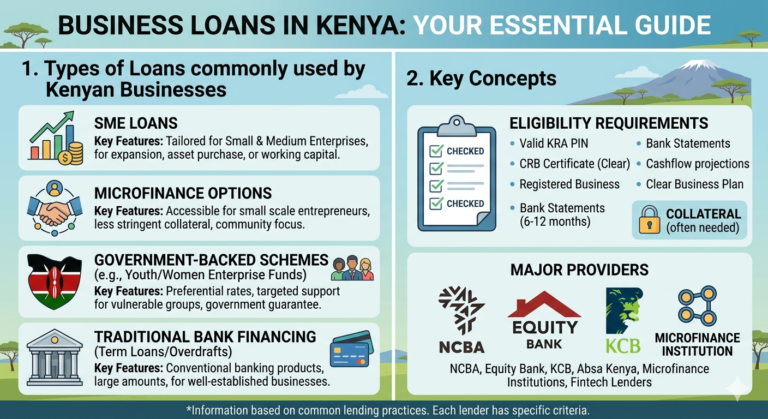
- Access to formal credit becomes possible. Banks, SACCOs, and government lending schemes require a Certificate of Incorporation or Registration to process business loans. The CBK’s 2022 MSME credit report showed 1.18 million active MSME loan accounts worth KES 783.3 billion — accessible only to registered businesses.
- Government tenders require registered businesses. Kenya’s Public Procurement and Asset Disposal Act bars unregistered entities from tendering for government contracts — cutting off one of the largest buyer markets in the country.
- Your business name is legally protected. An unregistered name can be registered by a competitor the same day. Registration gives you exclusive rights to that name within Kenya.
- You can open a dedicated business bank account. Every major Kenyan bank — Equity, KCB, Co-op, NCBA — requires registration documents before opening a business current account.
- The informal sector carries risk. According to Kenya National Bureau of Statistics data, 5.85 million of Kenya’s 7.41 million MSMEs operate informally — missing out on financing, legal protection, and formal market access.
- County Single Business Permits require registration. You cannot legally apply for an operating permit from your county government without first registering your business through BRS.
- BRS V2 in 2026 has made it genuinely fast. Name search and registration are now merged into a single payment step — eliminating the separate name-search fee that older guides still describe. Many competitor articles still reference the old two-step payment process, which is no longer the current procedure.
Registration is not a bureaucratic hurdle. It is the foundation that makes every other business milestone — funding, banking, tenders, and growth — accessible. The next question is which registration type fits your situation.
Types of Business Structures You Can Register in Kenya
Sole Proprietorship (Business Name)
A sole proprietorship registers under your own name or a trading name — for example, “Jane Wanjiku Trading As Zuri Creations.” You and the business are legally the same person, meaning you carry personal liability for any debts. The fee is KES 950 (covering name search and registration combined in 2026), and approval typically takes 1 to 3 working days. This is the right structure for freelancers, market traders, and solo service providers who want a quick, affordable legal identity without corporate complexity.
Partnership (Business Name)
A registered partnership works the same way as a sole proprietorship but involves 2 or more owners. All partners share personal liability for business debts. The fee remains KES 950, and the BRS form requires all partners’ National IDs, KRA PINs, and the agreed profit-sharing ratio. Critical: get a signed partnership deed drafted before registering — the BRS does not require it for registration, but disputes without one are extremely difficult to resolve.
Private Limited Company (Ltd)
The most common structure for serious businesses and the only entity that creates a fully separate legal person. The company can own property, enter contracts, and sue or be sued in its own name — shielding your personal assets from business liabilities. Requires at least 1 director and 1 shareholder (who can be the same person). The BRS government fee is KES 10,650, with a timeline of 3 to 7 working days on a complete application. This is the structure required for most government tenders, institutional bank accounts, and investor-ready businesses.
Limited Liability Partnership (LLP)
A hybrid structure combining the flexibility of a partnership with limited liability protection for each partner. Governed by the Limited Liability Partnerships Act 2011, it is widely used by professional firms — law offices, accounting practices, and consulting groups. Requires a minimum of 2 partners. The BRS fee mirrors the private company rate. Each partner’s liability is limited to their agreed contribution, unlike in a traditional partnership.
Branch of a Foreign Company
Foreign businesses with an established parent company register a branch under Part XXXVI of the Companies Act 2015. The branch must be registered within 30 days of establishing a place of business in Kenya. Note: branches are treated as foreign entities for tax purposes, attracting a slightly higher corporate tax rate than a Kenya-incorporated entity. A local representative or agent must be named in the application.
Public Limited Company
Requires a minimum of 7 shareholders and 2 directors, with no maximum shareholder cap. Public companies can offer shares to the public through the Nairobi Securities Exchange (NSE). This structure is appropriate only for large-scale businesses planning capital-market access — not for typical startups or SMEs.
What You Need Before You Start the Registration Process
Gather everything below before logging into eCitizen. Missing one item mid-application causes session timeouts and delays.
- ✅ Active eCitizen account (register at ecitizen.go.ke using your National ID)
- ✅ Valid Kenyan National ID or passport (front and back scan)
- ✅ Active KRA PIN (individual PINs for all directors and shareholders)
- ✅ Passport-sized photograph (clear, recent, white background, JPEG or PNG)
- ✅ Up to 3 proposed business names in order of preference
- ✅ Physical and postal address for the registered office (must be in Kenya)
- ✅ Brief description of proposed business activities
- ✅ Shareholding structure details (for companies): who owns what percentage
- ✅ M-Pesa line, debit card, or credit card for payment
- ✅ Beneficial ownership details (for companies): anyone holding 10% or more of shares
Access Point Comparison
| Route | Best For | Platform |
|---|---|---|
| Self-registration on eCitizen | Solo founders comfortable with online forms | ecitizen.go.ke |
| BRS V2 portal | Business name registrations — fastest route | brs.go.ke |
| Professional agent | Complex structures, foreign ownership, multiple shareholders | Licensed company secretaries |
What Business Registration Costs in Kenya — 2026 Real Figures
Most competitor articles still cite ranges or outdated figures. Here are the confirmed 2026 numbers.
Business Registration Costs in Kenya — 2026
| Registration Type | Govt Fee | Agent/Professional Fee | County Permit (Typical) | Best For |
|---|---|---|---|---|
| Business Name (Sole/Partnership) | KES 950 | KES 2,000 – 5,000 | KES 5,000 – 20,000+ | Solo traders, freelancers |
| Private Limited Company | KES 10,650 | KES 10,000 – 30,000 | KES 5,000 – 20,000+ | Startups, investor-ready businesses |
| LLP | KES 10,650 | KES 15,000 – 35,000 | KES 5,000 – 20,000+ | Professional practices |
| Branch Registration | Varies | KES 30,000 – 60,000+ | KES 5,000 – 30,000+ | Foreign parent companies |
| CR12 Certificate (post-registration) | KES 650 | N/A | N/A | Director/shareholder searches |
Sources: M&A Registrars fee schedule (March 2026), Biz Brokers Kenya (March 2026), Tuko.co.ke (February 2026). Note: The former two-step name search + registration payment has been replaced by a single combined KES 950 payment in 2026 for business names. Some older guides still describe two separate payments — that information is outdated.
How to Register a Business in Kenya: Step-by-Step
1. Create your eCitizen account at ecitizen.go.ke if you do not already have one. Use your National ID number to register. You will receive a one-time password (OTP) via SMS for verification. This account becomes the permanent home for all your business registration documents.
2. Log in and navigate to the Business Registration Service (BRS) tile on your eCitizen dashboard. Select BRS V2 for business name registrations or the company registration flow for private limited companies.
3. Submit your proposed business names — up to 3, in order of preference. The system checks availability automatically. Rejected names slow your application by 1 to 3 days, so choose distinctive names that avoid restricted words like “Kenya,” “Government,” “Bank,” or “Authority” without special permission.
PRO TIP: Avoid generic descriptive names — “Nairobi General Supplies” will likely be rejected or confused with existing registrations. Combine a unique word with your business activity, for example “Muturi Agri Supplies” or “Zawadi Tech Solutions” — specific names clear faster and are harder for competitors to mimic later.
4. Complete the registration form with all required details: physical registered office address, business activities description, director/owner IDs, KRA PIN numbers, and shareholding structure (for companies). For sole proprietorships, this step is straightforward. For companies, have your shareholding percentages agreed before you sit down — changing them mid-application requires restarting.
5. Upload all required documents. For a business name: your scanned ID and passport photo. For a private limited company: IDs or passports of all directors and shareholders, KRA PIN certificates, passport photos, and beneficial ownership details (Form BOF1 for anyone holding 10% or more of shares or voting rights).
6. Review every detail on the confirmation screen before proceeding. A typo in your ID number or KRA PIN causes a mismatch that triggers a query from the registrar — adding 3 to 5 days to your timeline. Check every field twice.
PRO TIP: The beneficial ownership section trips up most first-time company applicants. You must name the natural person who ultimately controls the business — not just the corporate entity. If you have a holding company as a shareholder, you must trace ownership to the individual human being who controls it.
7. Pay the registration fee through the eCitizen payment interface using M-Pesa, debit card, or credit card. The portal invoice generated at this step is the authoritative amount — use it, not the general fee schedule figures quoted elsewhere. Keep the M-Pesa transaction message as your proof of payment.
8. Monitor your application status through your eCitizen account. Standard business name applications take 1 to 3 working days. Private limited company applications take 3 to 7 working days on a complete file. BRS will notify you via email and eCitizen when the certificate is ready.
9. Download your Certificate of Registration (for business names) or Certificate of Incorporation (for companies) directly from your eCitizen account under “My Applications.” Save this document in at least 2 digital locations — Google Drive and email — immediately after downloading.
You have now completed business registration in Kenya. Here is what to expect next: your registration certificate is not the finish line — proceed immediately to KRA PIN registration, county permit application, and opening your business bank account.
Common Mistakes That Delay or Reject Business Registration in Kenya
MISTAKE: Submitting only one proposed business name WHY IT HAPPENS: Founders are attached to one name and assume it will be available. THE FIX: Always submit 3 names in order of preference. If your first choice is taken — which is common for popular words — the registrar moves to your second choice automatically, saving you 2 to 3 days compared to resubmitting.
MISTAKE: Using a KRA PIN that does not match your ID details WHY IT HAPPENS: Some applicants updated their ID but not their KRA PIN profile, or vice versa. THE FIX: Before applying, log into the KRA iTax portal and confirm your PIN details — name, ID number, and date of birth — exactly match your National ID. A mismatch triggers a registrar query that freezes your application.
MISTAKE: Choosing a business name with restricted words WHY IT HAPPENS: Words like “Kenya,” “National,” “Government,” “Authority,” “Bank,” or “Insurance” require special permission from the relevant regulatory body before BRS will approve them. THE FIX: Remove restricted words from your proposed names entirely unless you have the requisite approvals. Check the BRS guidance page at brs.go.ke for the current restricted words list before submitting.
MISTAKE: Skipping the beneficial ownership (BOF1) requirement for companies WHY IT HAPPENS: Most guide articles in Kenya either do not mention BOF1 or describe it as optional — it is not optional for companies. THE FIX: For every natural person holding 10% or more of shares or voting rights in the company, complete the BOF1 Beneficial Ownership form before submitting. Incomplete BO details are among the top causes of delayed company registrations in 2025 and 2026.
MISTAKE: Treating the Certificate of Registration as the final compliance step WHY IT HAPPENS: Founders celebrate getting the certificate and delay the post-registration steps for months. THE FIX: Your certificate is not a trading licence. You still need a company KRA PIN (separate from your personal PIN), a county Single Business Permit, and sector-specific licences for regulated activities. None of these are automatic — you must apply for each one separately after registration.
MISTAKE: Paying an unverified agent before using eCitizen yourself WHY IT HAPPENS: Facebook and WhatsApp groups are filled with “agents” charging KES 5,000 to KES 10,000 to register business names that cost KES 950 on eCitizen directly. THE FIX: For a sole proprietorship or partnership, the eCitizen process is straightforward enough to do yourself. Save the agent fee. If you genuinely need a professional — because you have foreign shareholders, a complex ownership structure, or multiple directors — hire a licensed company secretary or advocate, not an unverified social media agent.
MISTAKE: Registering the wrong business structure for your actual needs WHY IT HAPPENS: Most Kenyans register a business name because it is cheaper, without realising it offers no personal liability protection or investor appeal. THE FIX: If you plan to take on business loans, apply for government tenders, bring in co-founders, or grow to a team larger than 3 people, register a private limited company from the start. Converting from a business name to a company later requires a separate application and fees.
What Happens to Your Business After Registration — The Steps Most Guides Skip
Every guide covering how to register a business in Kenya ends at the Certificate of Incorporation. This one does not — because what happens in the 30 days after registration determines whether your company functions or stalls.
Step 1: Register your company KRA PIN within 30 days of incorporation.
Your personal KRA PIN is not your company’s PIN. Your incorporated business is a separate legal entity and requires its own PIN before it can file corporate tax, invoice government clients, or open a business bank account. You apply through the KRA iTax portal at itax.kra.go.ke under “New PIN Registration” — select “Non-Individual” and follow the prompts. BRS V2 now auto-generates a company KRA PIN in many cases, but confirm this in your eCitizen portal output before assuming it has been done.
Step 2: Apply for your county Single Business Permit.
Every business trading within a Kenyan county requires a Single Business Permit (SBP) from the county government. Fees vary significantly — from KES 5,000 for small home-based businesses to KES 100,000 or more for large commercial premises — and are calculated based on your business type, premises size, and county of operation. In Nairobi, applications are processed through the Nairobi City County e-portal. In Nakuru, Mombasa, Kisumu, and other counties, check the specific county website or visit the County Revenue offices. Operating without a current SBP is an offence under the County Governments Act — county inspectors do enforce this, particularly in town centres.
Step 3: Open a dedicated business bank account within 30 days.
A business bank account separates your personal finances from company finances — a requirement that tax authorities, investors, and auditors will expect. Banks typically require your Certificate of Incorporation, CR12 (official search showing current directors), company KRA PIN certificate, the IDs of all directors, and a resolution authorising account opening. The CR12 costs KES 650 and takes 3 to 5 days from BRS — apply for it the same day you download your incorporation certificate so it is ready when you visit the bank.
Step 4: Get sector-specific licences if your business is regulated.
Certain industries require additional licensing before you can legally operate, regardless of business registration status. A food business needs a Public Health Certificate from the county. A pharmacy requires a Kenya Pharmacy and Poisons Board licence. A money-lending business needs a CBK Digital Credit Provider licence. A law firm requires admission to the roll of advocates. Research your sector’s requirements on the relevant regulatory body’s website — BRS registration alone does not cover these.
Step 5: Start building your business profile where clients can find you.
Registration gives you legal existence. Visibility gives you revenue. Once your documents are in order, list your business on platforms where potential customers and leads are actively searching. Sign up free on LeadsPro to get your business in front of verified leads — it is one of the fastest ways to start generating business activity from a newly registered entity.
This post-registration phase is where most newly registered Kenyan businesses lose momentum. The certificate arrives, the excitement fades, and six months pass without action. Treat the day you download your certificate as Day 1 of a 30-day compliance sprint — not as the finish line.
Future Trends in Business Registration in Kenya
Full automation of compliance is accelerating. The BRS V2 platform already auto-generates KRA PINs for newly incorporated companies in some cases. The next phase, expected through 2026 and 2027, involves further integration with county permit systems so that single business permits can be applied for directly from within the eCitizen BRS flow — reducing the current multi-portal compliance journey to a single session.
Beneficial ownership enforcement is tightening. The Companies (Beneficial Ownership Information) Regulations 2020 have been in force for years, but enforcement was inconsistent. As Kenya advances its Financial Action Task Force (FATF) commitments, BRS and KRA are cross-referencing BO declarations more rigorously. Businesses with incomplete or inaccurate BO disclosures will face greater scrutiny and potential penalties in 2026 and beyond.
Digital nomads and foreign founders are a growing segment. Kenya’s Startup Act provisions and the Business Visa framework are making it easier for non-citizen founders to establish companies. BRS is working on clearer digital pathways for foreign-owned structures. According to Business Daily Africa, Kenya attracted significant foreign direct investment interest in 2025, and simplifying company formation for foreign founders is a stated government priority.
E-signatures are replacing wet signatures. BRS V2 already accepts digital submissions without physical document originals for most standard registrations. The full implementation of the Kenya Information and Communications (Electronic Certification and Domain Administration) Regulations means that more post-incorporation filings — including annual returns — will accept legally valid e-signatures, reducing the need for physical document handling.
SME formalisation remains a national policy priority. Kenya’s Draft MSME Policy 2025 targets reducing the 5.85 million unlicensed businesses by creating simplified, low-cost registration pathways for micro-enterprises. If implemented, this could include a micro-business category with reduced fees and simplified compliance requirements — opening registration to traders currently priced out of the current KES 950 minimum.
QUICK POLL: What is the biggest obstacle stopping you from registering your business in Kenya? A) The registration fees are too high for my current income B) The eCitizen process is confusing and I am scared of making mistakes C) I did not know registration was this simple and affordable D) I am waiting until my business grows before registering formally
Frequently Asked Questions About Registering a Business in Kenya
Q: How much does it cost to register a business in Kenya in 2026? A: A business name (sole proprietorship or partnership) costs KES 950, which now covers both name search and registration in a single combined payment under BRS V2. A private limited company costs KES 10,650 in government fees — the BRS invoice at the time of payment is the authoritative amount. Additional costs include a county Single Business Permit (KES 5,000 to KES 20,000+ depending on county and business type) and, if you use a professional agent, service fees of KES 2,000 to KES 30,000.
Q: How long does it take to register a business in Kenya? A: A business name takes 1 to 3 working days once all details are correctly submitted. A private limited company takes 3 to 7 working days on a complete application. In practice, most delays come from mismatched ID or KRA PIN details, weak backup business names, or incomplete beneficial ownership disclosures — not from BRS processing speed.
Q: Can I register a business in Kenya without going to Nairobi? A: The entire registration process is online through ecitizen.go.ke. You can apply, pay, and download your certificate from any location in Kenya with internet access — including on a mobile phone. No physical office visit to BRS or any government ministry is required.
Q: Do I need a lawyer to register a business in Kenya? A: For a sole proprietorship or partnership business name, no — the eCitizen process is straightforward. For a private limited company with multiple shareholders, foreign owners, or a complex shareholding structure, hiring a licensed company secretary or advocate reduces the risk of errors that delay approval. Do not use unverified social media “agents” charging KES 5,000 to KES 10,000 for a process that costs KES 950 on eCitizen.
Q: Can a foreigner register a business in Kenya? A: Foreigners can register a private limited company in Kenya. They cannot register a simple business name (sole proprietorship) without meeting specific local residency conditions. Foreign-owned company applications require passport copies instead of ID copies, and the beneficial ownership documentation must trace to the foreign nationals ultimately controlling the entity. Branch registration requires that the parent company be established outside Kenya and that a local representative be named.
Q: What is the difference between a business name and a private limited company in Kenya? A: A business name (sole proprietorship) does not create a separate legal entity — you and the business are legally the same person, meaning personal assets can be used to settle business debts. A private limited company is a separate legal entity with its own rights, assets, and liabilities — your personal assets are protected from business debts beyond your share capital. Companies also have greater credibility with banks, government bodies, and institutional clients.
Q: What happens if I do not file annual returns for my registered company? A: Every registered private limited company must file annual returns with BRS to remain in good standing. Missing annual returns results in penalties and can ultimately lead to the company being struck off the register — effectively delisting it from legal existence. The Companies Act 2015 requires annual returns to be filed within 42 days of the company’s anniversary of incorporation. BRS can issue penalty notices and strike off non-compliant companies.
Q: Can I start trading immediately after my business is registered? A: You can use your registered business name legally once you receive your certificate. However, you cannot issue valid tax invoices until you have a company KRA PIN, you cannot operate commercially in most counties until you hold a current Single Business Permit, and regulated industries require sector-specific licences before trading. Start the post-registration compliance steps the same day you download your certificate.
My Experience Researching Business Registration in Kenya
Researching this guide involved reviewing the BRS official website (brs.go.ke), the eCitizen portal documentation, M&A Registrars’ 2026 fee guide, Kazi Legal’s company registration page (updated March 2026), Biz Brokers Kenya’s incorporation guide, Tuko.co.ke’s cost breakdown (February 2026), and the KNBS MSME survey data cited in Kenya’s Draft MSME Policy 2025. Cross-referencing these sources against each other revealed the key factual inconsistency that confuses most guides: the BRS fee schedule shows KES 10,650 for a private company while some BRS FAQ flows show KES 10,750. The honest answer is to rely on your eCitizen portal invoice — that figure is final.
What surprised me: how few guides explain the post-registration steps clearly. Every article covers how to submit your application and download the certificate. Almost none cover the KRA company PIN, the county Single Business Permit timeline, or the beneficial ownership (BOF1) requirement — which is now one of the most common causes of private company registration delays in Kenya.
What disappointed me: the number of Facebook and WhatsApp agents still charging KES 5,000 to KES 10,000 to register business names that cost KES 950 on eCitizen directly. This is a clear exploitation of people who do not know the process — and the answer is straightforward documentation like this.
My honest recommendation: register yourself using eCitizen for a simple sole proprietorship. For a private limited company with multiple shareholders or any foreign involvement, the KES 10,000 to KES 15,000 you pay a licensed company secretary is worth avoiding the delays, errors, and beneficial ownership confusion that trip up first-time founders. Once your business is registered, Sign up free on LeadsPro and start generating leads before you even finish your post-registration compliance checklist.
Key Takeaways
- Business registration in Kenya is fully online through ecitizen.go.ke under the Business Registration Service (BRS) — no Nairobi visit required from any county.
- A business name (sole proprietorship/partnership) costs KES 950 in 2026, combining name search and registration into one payment — the old two-step fee is no longer current.
- A private limited company costs KES 10,650 in government fees, takes 3 to 7 working days, and requires beneficial ownership (BOF1) disclosures for anyone holding 10% or more of shares.
- The most common delays are: mismatched KRA PIN and ID details, weak backup business names, and incomplete beneficial ownership information — not BRS processing speed.
- Your Certificate of Registration or Incorporation is not a trading licence — you still need a company KRA PIN, county Single Business Permit, and any sector-specific licences before operating.
- Over 5.85 million Kenyan MSMEs operate without formal registration, missing out on bank credit, government tenders, and legal protection that registration provides.
- Never pay unverified social media agents KES 5,000 to KES 10,000 for business name registration — the same process costs KES 950 directly on eCitizen and takes 3 steps.
- Apply for your CR12 certificate (KES 650) the same day you download your incorporation certificate — banks will need it for account opening, and it takes 3 to 5 days.
Conclusion
Knowing how to register a business in Kenya is the first practical step from having an idea to running a legal entity that banks, clients, and government bodies will take seriously. The process is genuinely accessible — KES 950, a smartphone, and 30 minutes of focused attention is all a sole proprietor needs. If your situation is more complex — a company with multiple shareholders, or foreign co-founders — the government fee remains the same; the extra investment goes into getting the documentation right the first time.
Take the first step today: log into ecitizen.go.ke and start your application while this guide is still open in front of you. Once your certificate is ready, Sign up free on LeadsPro so your newly registered business starts getting in front of verified customers from day one.
What is the biggest thing that has been holding you back from registering your business — the cost, the process, or simply not knowing it was this straightforward?
Sources and References
- Business Registration Service — BRS Official Website — Official government fee schedule and BRS registry statistics
- M&A Registrars — Business Registration Fees Kenya 2026 — Detailed 2026 BRS fee guide with official source references
- Kazi Legal — How to Register a Company in Kenya 2026 — Requirements, costs, timelines, and beneficial ownership guidance (updated March 2026)
- Tuko.co.ke — Cost of Registering a Company in Kenya 2026 — Fee breakdown and post-registration compliance steps (February 2026)
- Kenya National Bureau of Statistics — MSME survey data on 7.41 million MSMEs in Kenya, 5.85 million unlicensed
- Kenya MSME Secretariat — Draft MSME Policy 2025 — Policy framework including MSME employment and GDP contribution statistics
- Webgaro — How to Register an Online Business Name in Kenya 2026 — BRS V2 step-by-step process and fee breakdown (March 2026)
- Business Daily Africa — Kenya Business Environment and FDI Coverage — Reporting on Kenya’s business formation trends and foreign investment climate
POLL ANSWER: C) I did not know registration was this simple and affordable — Research into Kenya’s informal business sector consistently shows that information gaps — not financial barriers — are the primary reason millions of entrepreneurs remain unregistered. The KNBS MSME data shows that of 7.41 million MSMEs, 5.85 million operate without licences. Interviews and surveys conducted by KIPPRA and the MSME Secretariat indicate that most informal operators assumed registration was expensive, required lawyers, or required multiple office visits. The shift to eCitizen BRS V2 has made KES 950 and a smartphone the only requirements for a sole proprietorship — but most potential registrants have not yet heard this.