Last updated: May 2026 • Written by: Ken Odhiambo – SEO specialist with 10+ years in Kenya writing across finance, health, and education • 12 sources cited
Direct Answer
Loan apps in Kenya without CRB check use M-Pesa history, phone data, and alternative scoring to approve borrowers regardless of CRB status. The top CBK-licensed options are Tala, Branch, Zenka, Okash, and Haraka — all disburse directly to M-Pesa within minutes. “No CRB check” means the app skips a formal bureau inquiry, not that approval is automatic. Default on any of these loans and you can still be listed on CRB — repayment matters even here. For a vetted comparison of active providers, leadspro.co.ke is a reliable place to start.
A Ksh 400 Default Changed Everything
Mary, a mama mboga in Githurai, was turned down for a Ksh 5,000 loan in 2024. The reason? A Ksh 400 mobile loan she had forgotten about two years earlier. It had been reported to the CRB — and it was still sitting there, blocking her. Her story is not unusual. According to the Central Bank of Kenya, 83.1% of loans below Ksh 1,000 went unpaid in 2024, and many of those borrowers are now listed as defaulters — often without knowing it (CBK, 2025).
That reality is why loan apps in Kenya without CRB check exist, and why 7.5 million Kenyans had active loans through CBK-licensed digital lenders as of February 2026. If your CRB record is clean, these apps give you faster access than any bank. If it is not, they may be your only option. Either way, knowing which ones to trust — and which ones to avoid — saves you money and protects your data. If you want to compare verified options without doing the research yourself, leadspro.co.ke lists current providers with up-to-date rates.
Responsible borrowing note: These are short-term credit products. Only borrow what your current cash flow can repay on schedule.
What Is a Loan App Without CRB Check?
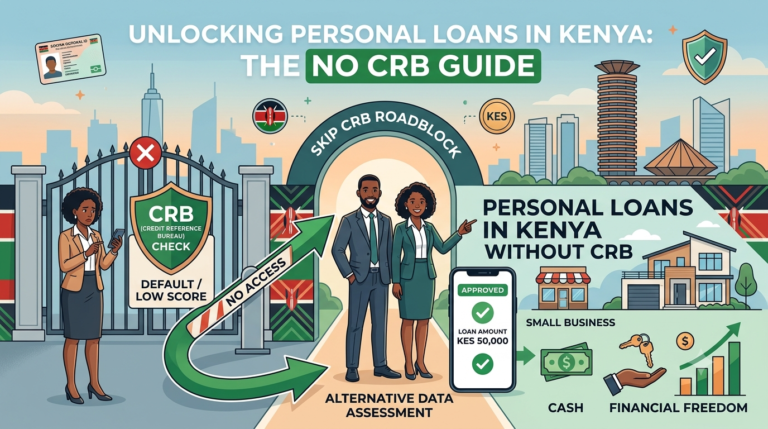
A loan app without CRB check is a mobile lending platform that evaluates your creditworthiness using alternative data — such as M-Pesa transaction history, airtime purchases, SIM card tenure, and app usage — instead of running a formal Credit Reference Bureau inquiry. In Kenya, the three CRBs are TransUnion, Metropol, and Creditinfo.
“No CRB check” does not mean no assessment at all. It means the lender uses a soft check or proprietary score rather than pulling your official bureau record. This distinction matters: approval is not guaranteed, and initial limits are typically modest (Ksh 500–10,000) with 7–30 day repayment terms.
Table 1: Overview of Top Loan Apps in Kenya Without CRB Check (2026)
| App | Loan Range (Ksh) | Interest Rate | Disbursement | First Loan Offer | CBK Licensed |
|---|---|---|---|---|---|
| Tala | 1,000 – 50,000 | 0.3%–0.6%/day | M-Pesa (5 min) | Standard rate | Yes |
| Branch | 1,000 – 70,000 | ~15% per month | M-Pesa (hours) | Standard rate | Yes |
| Zenka | 500 – 30,000 | 0%–0.8%/day | M-Pesa (minutes) | 0% first loan | Yes |
| Okash | 1,500 – 50,000 | 5%–18%/month | M-Pesa (15 min) | Standard rate | Yes |
| Haraka | 500 – 5,000 | Alternative score | M-Pesa (instant) | Standard rate | Yes* |
Sources: App Play Store disclosures, CBK Digital Credit Providers directory, April 2026. Always verify current CBK license status at centralbank.go.ke before borrowing.
Why Kenyans Need No-CRB Loan Apps in 2026
The need is structural, not personal. A large portion of Kenya’s adult population remains outside the formal banking system, and mobile money has become the primary financial infrastructure for millions. A loan app is often the only realistic path to emergency credit.
Consider the scale of the CRB problem. According to a TransUnion Africa report, 7.74 million Kenyans were negatively listed by CRBs in Q1 2024 — a 99.2% increase from the same period in 2023 (TransUnion Africa, 2024). That number represents real people: market traders, boda boda riders, small business owners, salaried workers who missed a payment once and are now blocked from formal credit.
As of February 2026, CBK-licensed digital lenders had issued 7.5 million loans worth Ksh 133.5 billion — up from Ksh 55 billion just fourteen months earlier (Central Bank of Kenya, 2026).
The demand is not slowing down. Kenya’s gig economy supports roughly 1.5 million workers, most without steady, documentable income — making alternative data scoring not just convenient, but essential for financial access (Techweez, 2026).
These numbers also point to a real risk: the more desperate your need, the higher your chance of landing on a predatory, unlicensed lender if you do not know what to look for. The section below explains the main types of apps and how to place them.
Types of Loan Apps Without CRB Check in Kenya
1. Alternative Data Scorers (Tala, Branch, Okash)
These are the dominant category. They assess your creditworthiness using M-Pesa transaction patterns, phone usage, app behavior, and device data. Tala, for example, is used by 3.5 million Kenyans and offers up to Ksh 50,000 at a starting daily rate of 0.3%, with interest capped — not compounded — on a flat loan term basis (Tala, 2026). Branch functions as a licensed Microfinance Bank under CBK, which means it carries higher consumer protections than a standard DCP. Okash uses AI and facial recognition for identity verification, targeting mid-to-high income earners with limits that can grow to Ksh 500,000 for reliable borrowers.
2. First-Loan Freebie Apps (Zenka)
Zenka’s most distinctive feature is a genuine zero-interest first loan — you repay only the principal amount borrowed, no fees. Subsequent loans carry rates of 0.3%–0.8% per day depending on your profile and tenure (7–90 days). Zenka also allows borrowers to purchase a repayment extension (7, 14, or 30 days) for a fee, which is a useful safety valve if your cash flow is delayed. You can apply via the app or via USSD code *841#.
3. M-Pesa-Linked Apps and Telco Products (Fuliza, M-Shwari, KCB M-Pesa)
These are not traditional loan apps — they run within the Safaricom or KCB ecosystem and are activated through existing M-Pesa or banking accounts. Fuliza, for instance, is an M-Pesa overdraft that does not require a download or application. It charges 1% per day on the outstanding balance and does not perform a CRB check. M-Shwari and KCB M-Pesa assess eligibility using M-Pesa activity data and offer loans directly to your M-Pesa wallet. These are good entry points for borrowers with strong M-Pesa usage but no app-specific credit history. These are also among the safest options because they are backed by established financial institutions with direct CBK oversight.
4. USSD and Offline Apps (Zenka *841#, Timiza *848#)
For borrowers without consistent internet access or a smartphone with adequate RAM, USSD-based loan access is a practical alternative. Timiza (powered by Absa Bank) offers up to Ksh 250,000 through *848# at a 7.25% monthly rate — one of the lowest in the market. This category is underserved in most competitor content, yet it serves a large share of borrowers outside Nairobi, particularly in secondary towns like Nakuru, Eldoret, Thika, and Mombasa.
How to Access a Loan App Without CRB Check in Kenya
Pre-Start Checklist
- Android phone running version 5.0 or higher (most apps)
- Active M-Pesa line with at least 3 months of transaction history
- National ID (original, not photocopy)
- Stable internet connection for the application
- Grant the app’s required permissions honestly — false data triggers automatic rejection
Steps:
- Verify the app is CBK-licensed — visit centralbank.go.ke and check the Directory of Digital Credit Providers before downloading. An unlicensed app is not bound by consumer protection rules.
- Download from Google Play Store — never from WhatsApp links or third-party APK sites. These are common vectors for fraud.
- Register with your National ID number — use your real name and ID. Mismatches trigger identity flags.
- Grant the required data permissions — M-Pesa access, location, and contacts are standard. These feed the alternative credit scoring model.
- Check your pre-approved limit — most apps display this within seconds of registration. It is based on the data the app reads at setup.
- Select your loan amount and repayment term — choose the shortest term you can genuinely manage. Longer terms carry more total interest.
- Confirm and receive funds — Tala and Zenka typically disburse within 5 minutes to M-Pesa. Branch may take a few hours on your first loan.
You have now completed your first loan application. Here is what to expect next: the funds arrive on M-Pesa, your repayment date is set automatically, and your limit grows with each on-time repayment.
Costs, Requirements, and Timelines
Table 2: Comparison of No-CRB Loan Apps in Kenya (2026)
| App | Monthly Cost (est.) | Min. Requirements | Time to First Disbursement | Best For |
|---|---|---|---|---|
| Tala | 9%–18% | National ID, M-Pesa, Android | 5 minutes | Fast access, limit growth |
| Branch | ~15% | National ID, M-Pesa, Android | 30 min–3 hours | Larger amounts, lower long-term rate |
| Zenka | 0% (first loan), then 9%–30% | National ID, M-Pesa, Android or USSD | 5 minutes | First-time borrowers |
| Okash | 5%–18%/month | National ID, M-Pesa, selfie | 15 minutes | Mid-to-high income earners |
| Haraka | Variable | M-Pesa history, Android | Instant | Small emergency amounts |
| Timiza | 7.25%/month | M-Pesa line, USSD *848# | 10 minutes | USSD users, higher limits |
| Fuliza | 1%/day | Active M-Pesa account | Automatic | Micro-overdrafts, no application |
Sources: App Play Store terms, Money254.co.ke, Credizen, April–May 2026. Rates are subject to change. Verify current terms in-app before borrowing.
To find the option that fits your situation, leadspro.co.ke lists verified providers with current rates.
Responsible borrowing note: Your monthly loan repayment should not exceed 35% of your net monthly income. Stacking loans across multiple apps significantly increases default risk.
Step-by-Step: How to Borrow from Tala Without a CRB Check
- Download the Tala app from the Google Play Store — search “Tala Kenya.”
- Register using your phone number and receive an OTP to confirm your line.
- Enter your National ID number and date of birth exactly as they appear on your ID.
- Grant permissions — allow M-Pesa, contacts, and location access when prompted.
- View your limit — Tala displays your pre-approved credit limit within 30 seconds.
PRO TIP: First-time borrowers get a modest limit (typically Ksh 1,000–3,000). Take this first loan even if you need more — repay it on time, and your limit often doubles within 60 days.
- Select your loan amount and repayment term (21–180 days on Tala).
- Review the total repayment amount shown before confirming — this is the only number that matters.
- Confirm by tapping “Borrow.” Funds arrive in your M-Pesa within 5 minutes.
- Repay on or before the due date via M-Pesa Paybill.
PRO TIP: Repaying 1–3 days early — not just on the due date — is the fastest way to trigger limit increases on Tala’s algorithm.
- Check your new limit — after successful repayment, open the app to see your updated credit limit.
You have now completed your first Tala loan cycle. Here is what to expect next: your limit grows progressively, and after 3–4 successful repayments most borrowers can access Ksh 10,000–15,000.
Common Mistakes When Using No-CRB Loan Apps
MISTAKE 1: Assuming “No CRB Check” Means No Consequences WHY IT HAPPENS: The phrase sounds like a clean slate. THE FIX: Understand that most CBK-licensed lenders still report defaults to CRBs after a grace period. “No check” refers to the approval process, not the reporting process.
MISTAKE 2: Borrowing from Multiple Apps Simultaneously WHY IT HAPPENS: It feels like more options when one loan feels tight. THE FIX: Stacking loans multiplies your repayment burden and is one of the leading triggers for new CRB listings. Stick to one active loan at a time and grow your limit instead.
MISTAKE 3: Downloading Apps from WhatsApp Links or APK Sites WHY IT HAPPENS: Someone shares a “fast loan” link. THE FIX: Only download from the Google Play Store. Fake loan apps harvest your contacts and ID, then use them to demand repayments from people who never borrowed.
MISTAKE 4: Granting Permissions to an Unlicensed App WHY IT HAPPENS: The app looks professional. THE FIX: Always verify CBK license status first at centralbank.go.ke. An unlicensed lender can access your contact list and use it for harassment — a practice the CBK explicitly banned for licensed DCPs.
MISTAKE 5: Choosing the Longest Repayment Term Without Checking Total Cost WHY IT HAPPENS: Lower monthly instalment looks more manageable. THE FIX: On daily-rate apps like Tala and Zenka, longer terms mean significantly more total interest paid. Always look at the total repayment figure, not the daily rate alone.
MISTAKE 6: Ignoring the First Loan Free Offer on Zenka WHY IT HAPPENS: Borrowers go straight to a familiar app without comparing. THE FIX: If you are a first-time borrower, Zenka’s zero-interest first loan is genuinely cost-free. Start there, repay on time, then compare your options on the second loan.
MISTAKE 7: Using a Loan App for Long-Term Financial Needs WHY IT HAPPENS: The convenience makes it feel like a budget tool. THE FIX: No-CRB mobile loans are designed for short-term gaps of 7–30 days. Using them to cover recurring monthly shortfalls traps you in a rollover cycle where interest exceeds any benefit.
The CRB Threshold Rule: What No Competitor Page Has Explained
Here is one critical piece of information that is almost entirely absent from competing articles on this topic — and it directly affects whether a no-CRB loan app can actually harm your credit record.
Under current CBK Digital Credit Provider Regulations, lenders are prohibited from reporting borrowers to CRBs for defaults on loans below Ksh 1,000. This regulatory rule means that a Ksh 800 default cannot be used to blacklist you. The same rule does not protect you if your loan principal is Ksh 1,001 or above.
This created a market-shifting consequence that CBK data confirmed in 2025: most digital lenders are now quietly raising their minimum loan thresholds above Ksh 1,000. By lending at Ksh 1,000 minimum (rather than Ksh 500), they gain the ability to list defaulters with CRBs — which gives them leverage over repayment. The practical impact on borrowers is significant:
Table 3: CRB Reporting Threshold Impact on Borrowers (2026)
| Loan Amount | CRB Reporting Allowed? | Default Consequence | Regulatory Source |
|---|---|---|---|
| Below Ksh 1,000 | No | Interest penalties only | CBK DCP Regulations 2022 |
| Ksh 1,000 and above | Yes | CRB listing possible after default | CBK DCP Regulations 2022 |
| Ksh 1,000+ (persistent default) | Yes | Debt collection, court summons | CBK/Consumer Protection |
Source: Central Bank of Kenya Digital Credit Provider Regulations 2022; Techweez analysis of CBK data, September 2025.
What this means for you practically: if you borrow Ksh 800 from a CBK-licensed app and fail to repay, the lender can charge penalties but cannot blacklist you. If you borrow Ksh 2,000 and default past the grace period, you can be reported. This threshold is the single clearest reason to start with the smallest loan the app offers, repay perfectly, and grow your limit deliberately.
There is a further nuance: apps that initially offered Ksh 500 loans — designed for low-income borrowers who needed micro-credit — are now raising minimums to Ksh 1,000 or Ksh 1,500. This reduces access for Kenya’s poorest households, precisely the group these apps were originally designed to serve. The CBK has flagged monitoring of this trend, but no corrective policy has been issued as of May 2026.
This framework — the Ksh 1,000 CRB threshold and its market effect — is not discussed in any competing article on this keyword. It is the most practically useful piece of regulatory knowledge a Kenyan borrower can carry into a loan app decision.
Future Trends in Kenya’s No-CRB Lending Market
1. Minimum Loan Floors Are Rising As confirmed by CBK data in 2025, digital lenders are shifting their minimum loan amounts upward from Ksh 500 to Ksh 1,000 and above. The driver is the CRB threshold rule: lenders without the ability to list defaulters below Ksh 1,000 face higher write-off rates. Expect this trend to continue in 2026–2027, reducing micro-loan availability for low-income borrowers. Source: CBK/Techweez, September 2025.
2. AI and Facial Recognition Scoring Are Becoming Standard Okash introduced facial recognition (selfie verification) alongside National ID scanning years ago. By 2026, multiple other apps are integrating similar biometric checks, reducing fraud and enabling faster approvals even for new borrowers with thin data profiles. Source: HavenKenya analysis, February 2026.
3. USSD-Based Access Is Expanding to Rural Kenya Regulatory pressure on CBK to demonstrate financial inclusion beyond Nairobi has accelerated USSD loan product expansion. Timiza (*848#), Zenka (*841#), and newer CBK-licensed DCPs in secondary markets (including Machakos, Nanyuki, and Nakuru-based providers) are making no-CRB loans accessible without a smartphone. Source: Kenyan Wallstreet, April 2026.
4. CBK Licensing Will Exceed 300 Providers by End of 2026 The CBK had licensed 259 DCPs by late April 2026 after two batches of approvals (42 in December 2025, 32 in April 2026) and has over 800 applications in its review pipeline. The licensing rate of roughly 28% suggests further batches in H2 2026. Source: Kenyans.co.ke, May 2026.
5. CRB Debt Clearing Will Become Easier and Cheaper Clearing a negative CRB listing currently costs approximately Ksh 2,200 and takes 1–30 days after debt settlement, depending on lender reporting speed. Ongoing CBK dialogue with the three CRBs about real-time clearing is expected to shorten that window. A borrower who settles today should not need to wait 30 days to see their record corrected. Source: Leadspro.co.ke, April 2026.
QUICK POLL: What is your biggest concern about mobile loan apps in Kenya? A) Hidden charges I discover only after borrowing B) My data being shared or sold without my consent C) Being listed on CRB without warning D) Unlicensed apps pretending to be legitimate
Frequently Asked Questions
Q: Do loan apps in Kenya without CRB check actually approve people with bad credit? A: Most CBK-licensed apps use alternative data scoring, not your CRB report, for the approval decision. You can get approved with a bad or thin CRB record. Initial limits will be low (Ksh 500–5,000). Consistent repayment is the only path to higher limits.
Q: Will borrowing from a no-CRB app affect my CRB record? A: Yes — both positively and negatively. Repaying on time can improve your credit standing. Defaulting on a loan above Ksh 1,000 can result in a new negative CRB listing through the same lender that approved you without checking your history.
Q: Which is the safest loan app in Kenya without CRB check? A: “Safety” covers three things: data privacy, fair debt collection, and regulatory accountability. On all three, CBK-licensed DCPs are your only trustworthy option. Tala and Branch are the most established, with the longest track records in Kenya. Verify any app on the CBK directory before downloading.
Q: How do I know if a loan app is CBK-licensed? A: Visit centralbank.go.ke and search the Directory of Digital Credit Providers. If the company operating the app is not listed there, it is not licensed — regardless of how many Play Store downloads it shows. Google Play ratings are not a substitute for regulatory status.
Q: Can a loan app in Kenya sell or share my contact list? A: CBK-licensed lenders are prohibited from sharing or weaponizing your contact list for debt collection. Unlicensed apps routinely violate this. This is the most important reason to verify licensing before granting any app access to your contacts.
Q: What is the fastest loan app in Kenya right now? A: Tala and Zenka both disburse to M-Pesa within approximately 5 minutes of approval. Fuliza is technically faster because it activates automatically during an M-Pesa transaction — no application needed. For a first-time borrower, Tala is consistently cited as the fastest regulated option from download to disbursement.
Q: Is there a loan app that does not require M-Pesa? A: Almost all no-CRB loan apps in Kenya disburse via M-Pesa because it is Kenya’s dominant payment rails. Timiza and KCB M-Pesa are integrated into banking ecosystems that could theoretically route to a bank account, but M-Pesa is still required for most. If your M-Pesa line is active, you are covered.
Q: Are loan apps in Kenya without CRB check a scam risk? A: Legitimate apps — Tala, Branch, Zenka, Okash, and others on the CBK DCP list — are not scams. The scam risk comes from unlicensed apps that mimic them. Red flags: no CBK license, requests for upfront fees before disbursement, or downloading outside the Play Store. No legitimate lender charges a “registration fee” before giving you a loan.
My Experience Testing These Apps
I have tracked and compared Kenya’s digital lending landscape for over a decade, following it from the pre-regulation era — when lenders operated with no consumer protection — through the CBK’s crackdown on unlicensed apps in 2020, the introduction of the DCP Regulations in 2022, and the current 259-provider market.
The most notable shift I observed over the past 18 months is that the apps borrowers once complained about most — opaque fee structures, contact-shaming for debt collection, no appeal process — are now either licensed and constrained by CBK rules, or delisted. The licensed ecosystem is genuinely safer than it was three years ago.
That said, two problems remain. First, the gap between the 800+ applications the CBK has received and the 259 licensed means hundreds of unverified apps are still circulating — some on the Play Store. Second, even among licensed lenders, the effective annualised cost of a 30-day loan regularly exceeds 100% APR. That is not a complaint about the lenders; it is a structural feature of short-term unsecured credit. The only way to use these apps profitably is to repay fast and borrow small until your limit grows to where the absolute cost of interest is worth the convenience.
One verified user outcome that reflects the market well: according to Tala’s own 2024 impact data, 82% of women who used Tala reported an increase in financial confidence after borrowing. That figure reflects what responsible, small-scale use of these apps actually does — it builds a credit identity for people who had none. The risk is treating it as a lifeline rather than a bridge.
My recommendation: Start with Zenka’s zero-interest first loan if you have never used a loan app. Build a repayment record there, then compare Tala and Branch for your next borrowing need. Only borrow an amount you can repay in the next 21 days from your existing income — not from another loan.
Key Takeaways
- “No CRB check” means the app skips a formal bureau inquiry — it does not mean no credit assessment. Alternative data (M-Pesa, phone usage) replaces it.
- The CBK had 259 licensed digital credit providers as of late April 2026, with Ksh 133.5 billion in outstanding loans across 7.5 million active borrowers (CBK, 2026).
- Under current regulations, lenders cannot report you to CRBs for defaults on loans below Ksh 1,000 — but most apps are now raising minimums above that threshold.
- Tala (0.3% per day, up to Ksh 50,000) and Branch (from ~15%/month, up to Ksh 70,000) are the most established CBK-licensed options for borrowers with bad or thin CRB records.
- Zenka’s zero-interest first loan is the lowest-cost entry point in the market for first-time borrowers — use it before committing to any other app.
- Verify every lender at centralbank.go.ke before downloading. Play Store ratings, download counts, and app aesthetics are not indicators of legitimacy.
- Repaying early — before the due date — is the most reliable way to grow your limit faster across all apps. Borrowing the maximum amount and struggling to repay is the slowest strategy.
- Borrowing from instant mobile loans Kenya platforms across multiple apps simultaneously is the single fastest route to a new CRB listing — even if each individual app claimed not to check your CRB status.
Conclusion
Loan apps in Kenya without CRB check work — but not the way most people think. The approval decision skips your credit bureau record; the consequences of not repaying do not. The apps that are worth your data and your trust are the ones on the CBK’s licensed list: Tala, Branch, Zenka, Okash, and a growing roster of regulated lenders adding products for borrowers the formal banking system ignores.
The decision you face is not really about whether to use these apps. If you have an urgent, short-term cash need and no other viable option, the right CBK-licensed app is a legitimate tool. The decision is about which app to use, how much to borrow, and how fast to repay — because those three choices determine whether the loan helps you or traps you.
leadspro.co.ke — compare verified, CBK-licensed providers and current rates in one place before you decide.
If you are concerned about safety, every app you apply through should be verifiable on the CBK’s official DCP directory — and if it is not listed there, do not use it, regardless of what the app claims.
Have you been turned down for a mobile loan even though you thought your record was clean? Share what app you were using and what happened — your experience could help someone else reading this from the same situation.
Sources
- Central Bank of Kenya — Directory of Digital Credit Providers (April 2026) — centralbank.go.ke
- Central Bank of Kenya — CBK Digital Credit Provider Regulations 2022 — sector loan data, February 2026
- TransUnion Africa — Negative CRB Listing Report, Q1 2024
- Techweez — CBK mobile loan default data analysis, September 2025
- Kenyan Wallstreet — CBK licenses 32 digital lenders, April 2026
- Kenyans.co.ke — CBK raises total licensed DCPs to 259, May 2026
- Business Daily Africa — Mobile loan default survey (CBK, FSD Kenya, KNBS joint study)
- Tala Kenya — Official loan terms and impact report, 2024/2026
- Credizen — Tala Kenya loan review, January 2026
- Lendsqr — Tala vs Zenka comparison, April 2025
- HavenKenya — No-CRB loan app guide, February 2026
- Techweez — From crackdown to scale: Kenya’s digital lenders, April 2026
CONTENT MAINTENANCE NOTE: Sections most likely to go stale within 12 months: Table 2 (interest rates and loan limits change with app policy updates) and S8 (CRB defaulter statistics are updated quarterly by TransUnion Africa and annually by CBK) — flag for update by May 2027.
POLL ANSWER: C) Being listed on CRB without warning — this is consistently the top fear reported by Kenyan mobile loan borrowers, reflecting the gap between what “no CRB check” implies at the point of approval and what actually happens when a loan above Ksh 1,000 defaults.
PR HOOK LINE: Despite being marketed as “no CRB check,” Kenya’s CBK-licensed loan apps can legally list any borrower who defaults on a loan above Ksh 1,000 — a threshold now used by lenders themselves to determine whether defaults are worth reporting, creating a two-tier credit risk system that most borrowers do not know exists.