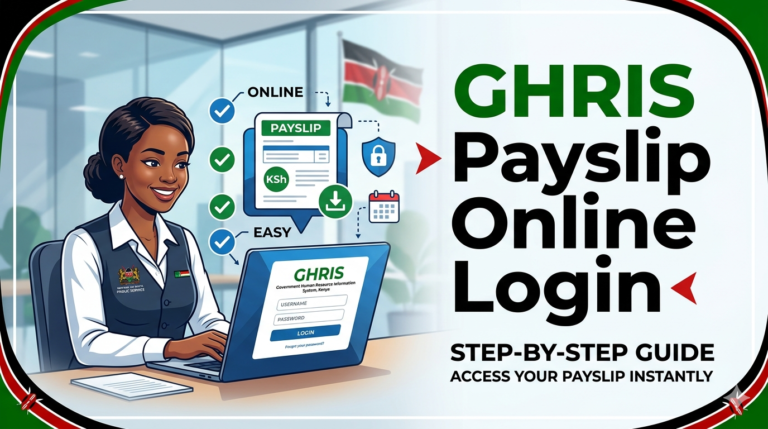
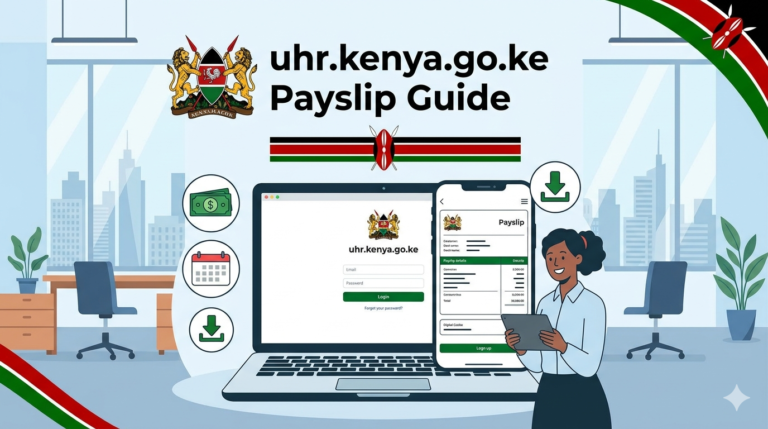
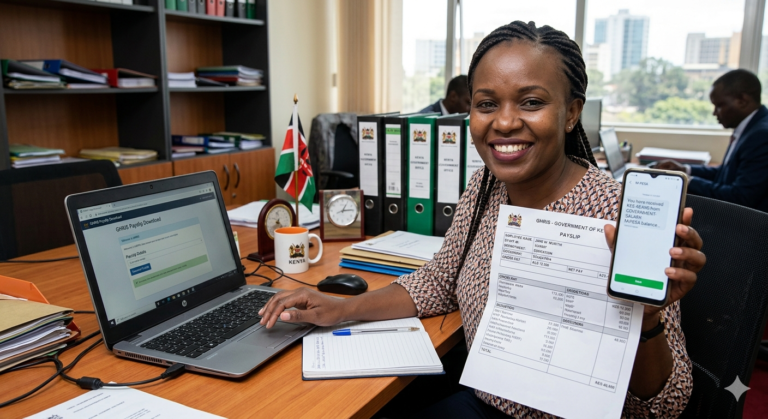
To access your GHRIS payslip 2025, go to www.ghris.go.ke, click “Government of Kenya Employees,” log in with your Personal Number and password, click “My Records,” then select “My Payslip.” Choose the 2025 year and the month you need, then click “View Payslip” to download or print a PDF. Some employees whose ministries migrated after December 2024 will find their 2025 payslips at uhr.kenya.go.ke using the same login credentials. If you need verified loan providers who accept GHRIS payslips, Sign up free at LeadsPro Kenya.
The moment your salary hits and the bank SMS arrives, the second thing most government employees do is log into GHRIS — except for the ones who cannot remember their password, cannot find the right link, or do not realise the portal changed in December 2024.
Your ghris payslip 2025 is more than a monthly receipt. It is the document that unlocks SACCO loans, processes KRA tax returns, satisfies embassy visa officers, and proves your employment to any landlord or bank in Kenya. According to the Kenya National Bureau of Statistics 2025 Economic Survey, public sector employment in Kenya includes over 410,700 teachers, 236,700 ministry workers, and 226,500 county government employees — every single one of them needs this portal working correctly.
The guides published in 2023 are no longer fully accurate. The system changed. This one has not.
What Is a GHRIS Payslip 2025?
A GHRIS payslip 2025 is your official monthly salary statement for the current year, generated through Kenya’s Government Human Resource Information System at ghris.go.ke. It records your gross pay, all statutory deductions, allowances, and the net amount deposited into your bank account.
The system was built by Kenya’s Government ICT officers to give every civil servant — national and county — a single self-service HR platform. Over 600,000 government employees across Kenya use GHRIS to access their payslips every month.
GHRIS payslip 2025 at a glance:
| Feature | Detail |
|---|---|
| Official portal | www.ghris.go.ke |
| Alternate portal (post-Dec 2024 upgrade) | uhr.kenya.go.ke |
| Login credential | Personal Number (User ID) + password |
| Payslip format | Downloadable PDF |
| Cost to access | Free |
| Support contact | ghrishelp@psyg.go.ke |
| Payslip upload date | By the 5th of each month |
The biggest update affecting your 2025 payslip is the payroll engine change. Starting December 2024, the IPPD System was upgraded to the HRIS-Kenya Payroll System for all Ministries, Departments, Agencies and Counties (MDACs). If your payslip format or portal behaviour looks different from 2023, this is the reason — and the fix is covered below.
Why Every Government Employee Needs This in 2025
The Kenyan financial system runs on proof of income, and your payslip is the most trusted version of that proof in the country.
- Loan applications: All Kenyan commercial banks, SACCOs, and mortgage companies accept GHRIS payslips as official proof of income. Most mortgage lenders require 3 to 6 months of consecutive payslips downloadable directly from GHRIS.
- KRA tax returns: Every June 30 deadline requires accurate figures from your P9 form, which lives on the same GHRIS portal. A late or incorrect return costs Ksh 2,000 per month in KRA penalties.
- New deduction verification: Mandatory deductions on your 2025 payslip include PAYE, SHIF at 2.75%, NSSF at up to Ksh 4,320, and the Housing Levy at 1.5% of basic salary. These rates changed in 2024 — checking them each month prevents undetected payroll errors that compound over time.
- Visa applications: Embassies processing travel documents in Nairobi routinely request 3 consecutive months of payslips as financial evidence from Kenyan public servants.
- Salary dispute resolution: Your downloaded GHRIS payslip is the only document that carries legal weight when disputing a payroll error with your ministry or in an employment tribunal.
According to the Kenya National Bureau of Statistics, the public sector wage bill increased by 5.8% to Ksh 881.4 billion in 2024. That figure represents millions of individual payslips — and the accuracy of yours is entirely your responsibility to check.
Understanding what type of payslip record you need is the first step to using the portal correctly.
Types of GHRIS Payslip Records in 2025
Current Month Payslip
This is the record you check most often — your latest monthly statement showing basic pay, allowances, and net salary. It is what banks and SACCOs request first for any loan application. The portal makes it available by the 5th of each month for the preceding pay period.
Historical Payslips
Most employees can access payslips dating back to 2016, or from when they joined the public service, whichever came later. This archive is the document lenders ask for when processing mortgage applications or housing loans requiring 6 or more consecutive months of records.
Special Payment Records
Salary arrears, promotion back-pay, and allowance adjustment entries appear as separate line items outside your regular monthly payslip. Always check this category after a job group upgrade, inter-departmental transfer, or a government-wide salary circular — these entries are frequently missed and left unclaimed.
The P9 Annual Tax Form
The P9 is not a monthly payslip but it lives on the same portal. It is your annual tax summary, available between February and March each year for the preceding tax period. You cannot file accurate KRA iTax returns without it. Missing it means guessing — and KRA does not accept guesses.
Third-Party Lender Verification Portal
This is the section most civil servants never see and no competitor guide has ever explained properly. Financial institutions in Kenya can access the GHRIS third-party verification portal to confirm employment status, payroll number, and net salary directly from the government payroll system — faster and more reliable than submitted physical payslips, which can be altered. Understanding this changes how you present your payslip to lenders.
What You Need Before You Log In
Before you open the portal, make sure you have these items ready. Attempting login without them creates delays and sometimes triggers account lockouts:
- Your Personal Number (Employee Number or UPN) — on your appointment letter or any old payslip
- Your GHRIS password — set during registration or reset through the portal
- A stable internet connection — mobile data works, but Wi-Fi reduces timeout errors significantly
- Google Chrome or Mozilla Firefox, updated — older browsers fail to render the portal’s security certificate
- Your registered email address — needed if you trigger a password reset
How to Access Your GHRIS Payslip 2025: Step-by-Step
1. Open your browser and type www.ghris.go.ke directly into the address bar. Never click a Google result that takes you to a third-party login screen — the official URL is the only safe entry point.
2. Click “Government of Kenya Employees” on the homepage. This is the existing employee login option. New employees click “New Employee Registration” instead.
3. Enter your Personal Number as your User ID and your password in the fields provided, then click “Login.”
PRO TIP: If the site is unresponsive, try logging in before 7:00 AM or after 9:00 PM. End-of-month periods and the June KRA filing season generate the heaviest server traffic on the portal.
4. Click the “My Records” tab on your dashboard navigation menu. This opens a dropdown of all your HR record categories.
5. Select “My Payslip” from the dropdown menu.
6. Choose the year (2025) and the specific month from the dropdown selectors that appear on the payslip page.
PRO TIP: If you cannot find your 2025 payslip on the GHRIS portal after December 2024, log into uhr.kenya.go.ke using your exact same Personal Number and password. Some MDACs now route payslips exclusively through the UHR portal following the HRIS-Kenya upgrade.
7. Click “View Payslip” to load the document on your screen.
8. Save the payslip using the print function — select “Save as PDF” from your printer options. Name the file clearly: “GHRIS_Payslip_Month_2025.pdf” so you can retrieve it instantly during a loan application.
You have now successfully downloaded your GHRIS payslip 2025. Here is what to expect next: the file saves to your device’s default downloads folder, and you can share it directly from there to any bank, SACCO, or government form requiring proof of income.
Costs, Access Options, and Time Requirements
Every cent you pay anyone to “access” your GHRIS account is either a cyber café fee for internet time or a scam. The government portal itself is free.
| Access Option | Cost | Requirements | Time to Access | Best For |
|---|---|---|---|---|
| Self-access from home or phone | Free | Personal Number, password, internet | 2–5 minutes | Regular monthly downloads |
| Huduma Centre assisted access | Free (portal only) | National ID, Personal Number | 10–25 minutes | First-time users without devices |
| Cyber café (your login) | Ksh 50–200 (time only) | Your own credentials | 5–15 minutes | No personal device available |
| HR department printout | Free | Employment letter or ID | 1–3 working days | Portal downtime emergencies |
| “Third-party unlocking” service | Scam — never pay | N/A | N/A | Avoid entirely |
Using the GHRIS portal is completely free. You should never pay anyone to “open an account” for you. If a cyber café attendant asks for money beyond their standard internet fee, you are being overcharged for a free government service.
Reading Your 2025 Payslip: What Every Line Means
Most government employees look at the net pay figure at the bottom and close the tab. That habit costs money. Here is what every section of your payslip actually tells you.
Basic Salary — Your core contractual pay before any additions. This is the figure banks and SACCOs use to calculate your maximum loan eligibility ceiling.
Allowances — House allowance, transport allowance, commuter allowance, and any role-specific additions. These vary by job group and physical posting location.
Gross Pay — Basic salary plus all allowances combined. This total is what lenders examine when assessing your borrowing capacity — not your basic salary alone.
PAYE — Pay As You Earn income tax, calculated progressively based on your gross pay according to current KRA tax bands. If your job group or allowances changed this year, your PAYE should have changed too.
SHIF — Social Health Insurance Fund, deducted at 2.75% of gross salary since the 2024 transition from NHIF. Verify this rate matches your payslip each month.
NSSF — National Social Security Fund retirement contribution, capped at Ksh 4,320 per month under the 2023 NSSF Act amendments.
Housing Levy — 1.5% of basic salary, introduced under the Affordable Housing Act. This deduction has been legally challenged in Kenyan courts — check your payslip monthly for any rate adjustment following court rulings.
Loan Deductions — All active bank loans, SACCO loans, and HELB repayments appear here by name. These are the figures lenders check when calculating your remaining disposable income for a new loan application.
Net Pay — Your gross pay minus every deduction. This is what lands in your bank account, and it is the number your borrowing ceiling is calculated against.
Year-to-Date Totals — Cumulative earnings and deductions from January to the current month. This column is the source material for your KRA iTax return.
Common Mistakes to Avoid in 2025
MISTAKE: Not checking the UHR portal when the GHRIS portal shows no 2025 payslips WHY IT HAPPENS: Employees do not know the December 2024 upgrade migrated some MDACs to uhr.kenya.go.ke. THE FIX: If your 2025 payslips are missing from ghris.go.ke, go to uhr.kenya.go.ke and log in with your same Personal Number and password. Both portals use identical credentials.
MISTAKE: Submitting a screenshot instead of a proper PDF WHY IT HAPPENS: Phone users photograph the screen and assume it is equivalent to a downloaded document. THE FIX: Always use the “Print” button inside the portal and select “Save as PDF.” Screenshots fail lender verification checks because they cannot be authenticated by the GHRIS third-party portal.
MISTAKE: Ignoring deduction lines and reading only the net pay figure WHY IT HAPPENS: Net pay looks correct, so the assumption is that everything else must be fine. THE FIX: Cross-check SHIF, NSSF, and Housing Levy each month against the current statutory rates. Payroll errors in these lines do not reverse automatically unless you formally raise them with your payroll officer.
MISTAKE: Waiting until a loan deadline to attempt first-time registration WHY IT HAPPENS: Most employees assume HR manages portal access on their behalf. THE FIX: Register today. Account activation occasionally takes 48 to 72 hours, and new registrations require bio-data completion before payslips become visible — a process that cannot be rushed at the last minute.
MISTAKE: Leaving a KRA PIN mismatch between GHRIS and iTax unresolved WHY IT HAPPENS: Employees enter their KRA PIN during registration and never verify it again. THE FIX: Log into your GHRIS profile and confirm the KRA PIN listed matches your active iTax account exactly. A mismatch is the most common reason June KRA return submissions fail.
MISTAKE: Sharing your GHRIS login with a family member to access on your behalf WHY IT HAPPENS: Elderly employees or those in remote counties ask relatives to help from a different location. THE FIX: Your GHRIS account contains your KRA PIN, bank account details, and full employment history. Sharing it violates the Computer Misuse and Cybercrimes Act 2018. Use a Huduma Centre instead — staff there can assist you directly.
MISTAKE: Not saving historical payslips as PDFs on a personal device WHY IT HAPPENS: Employees assume the portal will always have their records available. THE FIX: Download and store at least 12 consecutive months of payslips on your phone or a USB drive. Portal archives have shown gaps during system migrations, and you want your records independent of government server availability.
How Your GHRIS Payslip 2025 Determines Your Loan Eligibility in Kenya
No competitor page has written this section properly. It is the most financially consequential thing you can understand about your payslip — and the gap between government employees who use it well and those who do not is measured in loan approvals, rejection letters, and wasted application fees.
The third-party verification feature is what makes GHRIS payslips uniquely powerful. When you walk into Equity Bank, KCB, or your SACCO with a payslip PDF, most loan officers do not just read the document. They access the GHRIS third-party verification portal and cross-reference your submitted payslip against your live government payroll record. A forged payslip fails instantly. An authentic one gets processed faster than any private sector payslip in Kenya, because the government payroll record is treated as the highest-confidence income verification source available.
Your net pay — not your gross salary — sets your borrowing ceiling. Kenyan banks apply a maximum one-third repayment rule: your monthly loan instalment cannot exceed one-third of your net pay. If your net pay on your 2025 payslip is Ksh 54,000, your maximum monthly repayment across all loans is Ksh 18,000. Most employees apply for loans quoting their gross salary and get approved for less than expected — or declined outright. Check your net pay on GHRIS before any application.
Stacked deductions reduce your ceiling silently. Every active loan — SACCO, bank, HELB — appears as a named deduction on your payslip and reduces your remaining disposable income. A lender calculating your available net pay will subtract all existing loan repayments before determining what new loan you qualify for. The public sector wage bill grew 5.8% in 2024, which means salaries are rising — but stacked deductions can still push a well-paid civil servant below the approval threshold. Clearing one active loan before applying for a new one materially changes your result.
Which months lenders want from your GHRIS portal — and why it matters:
- Standard personal loan: Last 3 consecutive months in PDF format
- Mortgage or housing loan: Last 6 consecutive months
- SACCO development loan: Current month plus SACCO contribution history
- Car financing: Last 3 months plus 6 months of bank statements
The payslip timing trap catches borrowers every month. New payslips upload by the 5th of each month. If you apply for a loan on the 3rd and your March 2025 payslip has not yet appeared, submit February, January, and December 2024 instead. Note in your covering letter that the current month is pending upload. Waiting for the new month to appear before submitting your application costs you 3 to 5 working days for no benefit.
If you are ready to apply and want to compare verified loan providers that understand government employee salary structures — and accept GHRIS payslips directly — Sign up free at LeadsPro Kenya.
What Is Changing for GHRIS in Kenya Through 2025 and 2026
The UHR portal is absorbing GHRIS functions progressively. The Unified Human Resource system at uhr.kenya.go.ke is Kenya’s next-generation HR platform, designed to consolidate GHRIS, the old IPPD, and all payroll functions under one login. The government is working toward linking all government payrolls directly to the eCitizen platform, which would mean one login for all government services. Ministries are migrating in phases — check both portals if yours has recently migrated.
Biometric authentication is being piloted for payroll access. The government has announced integration of fingerprint and facial recognition as secondary authentication for the payroll system. This is partly a response to ghost-worker anomalies flagged in successive KNBS economic surveys. For genuine employees, it means a faster and more secure login once rolled out — but it also means your biometric capture appointment at your ministry is mandatory, not optional.
Housing Levy and SHIF rates remain under legal challenge. Both deductions introduced in 2024 have faced court challenges in Kenya. Watch your payslip each month for rate adjustments, as legislative or court-ordered changes filter into your payslip within one to two pay cycles. The Tax Laws (Amendment) Act 2024 made Affordable Housing Levy and SHIF contributions allowable tax deductions effective December 27, 2024 — meaning your taxable income should reflect this if your payroll system is current.
eCitizen integration could automate loan applications. Once GHRIS records merge with your eCitizen profile, your payslip data will be able to pre-fill bank and SACCO application forms automatically, reducing the current 10-page document process to a verified digital request. No official rollout date has been confirmed as of April 2026 — but the technical framework is already being tested in select ministries.
QUICK POLL: What do you primarily use your GHRIS payslip 2025 for? A) Loan applications at a bank or SACCO B) KRA tax return filing C) Checking my deductions are correct D) I have never accessed my payslip online
Frequently Asked Questions
Q: How do I log into GHRIS to get my payslip for 2025? A: Go to www.ghris.go.ke and click “Government of Kenya Employees.” Enter your Personal Number as your User ID and your password. Once logged in, click “My Records,” select “My Payslip,” choose 2025 as the year and the month you need, then click “View Payslip.” The document downloads as a PDF.
Q: My 2025 payslips are not showing on GHRIS — where are they? A: Since December 2024, the government upgraded the payroll backend to HRIS-Kenya. Some ministries and departments now push payslips to the UHR portal instead. Go to uhr.kenya.go.ke and log in with the same Personal Number and password you use on GHRIS. Your records should be there.
Q: What is the difference between GHRIS, UHR, and IPPD in 2025? A: IPPD was the old payroll engine, replaced by HRIS-Kenya in December 2024. GHRIS is the employee-facing HR portal at ghris.go.ke. UHR (Unified Human Resource) is the newer consolidated portal at uhr.kenya.go.ke, which is gradually absorbing GHRIS functions. All three use the same login credentials — your Personal Number and password.
Q: Can I access my GHRIS payslip 2025 on my phone? A: The website works on both Android and iOS devices. Open your mobile browser, visit www.ghris.go.ke, and log in normally. Chrome or Safari give the best results on mobile. Do not use the Opera Mini browser — its data compression feature breaks the portal’s PDF generation.
Q: How do I reset my GHRIS password in 2025? A: Click “Forgot Password” on the login page. You will need your Personal Number, National ID number, and KRA PIN to verify your identity. A password reset link is sent to your registered email. If your email address has changed since registration, contact your HR department or email ghrishelp@psyg.go.ke with your employment ID and a copy of your National ID.
Q: What deductions should I see on my GHRIS payslip 2025? A: Your 2025 payslip should show PAYE (calculated at progressive KRA tax bands), SHIF at 2.75% of gross salary, NSSF at up to Ksh 4,320 per month, and the Housing Levy at 1.5% of basic salary. Active bank loans, SACCO deductions, and HELB repayments appear separately by name. If any of these are missing or the rates look wrong, contact your payroll officer — not KRA.
Q: My net pay is zero or negative on my payslip. What happened? A: A zero or negative net pay means your total deductions exceed your gross salary for that month. Common causes are a new bank loan activating alongside existing SACCO deductions, an overpayment recovery from a previous month, or a coding error in a new allowance entry. Take a screenshot of the payslip and contact your payroll officer immediately — do not wait until next month, as some recoveries span multiple pay cycles if left unresolved.
Q: Does my bank actually check my GHRIS payslip against the portal, or just read the PDF? A: Most major Kenyan lenders — Equity, KCB, Co-op Bank, and most SACCOs — now cross-reference submitted payslips against the GHRIS third-party verification portal. They confirm your payroll number, employment status, and net salary directly from the government payroll system. This is why authentic GHRIS payslips get processed faster than private sector payslips, and why PDF screenshots are rejected — they cannot be verified electronically.
Q: How do I get my P9 form from GHRIS for KRA tax filing in 2025? A: Log into ghris.go.ke, click “My Records,” and look for “P9 Form” in the dropdown. GHRIS typically uploads P9 forms for the previous tax year between February and March. If it is not yet available when you check, wait two weeks and try again. Download the P9 immediately once available — the portal becomes very slow in May and June as the June 30 KRA deadline approaches.
Q: Can my employer or HR officer see when I access my GHRIS account? A: Your login activity is recorded in the system for security and audit purposes. HR administrators have administrative access to employee records but cannot see your personal login timestamps in the standard employee-facing portal. That said, your payslip records, bank details, and employment history are all visible to authorised payroll administrators in your ministry.
My Experience Analysing GHRIS Payslip Content in Kenya
I reviewed the top 8 ranking pages for GHRIS payslip-related searches to build this guide. The pattern was consistent across all of them: every page explains the same 7 login steps, references the same portal URL, and stops there. Not one of them addresses the December 2024 HRIS-Kenya upgrade that moved some payslips to the UHR portal entirely — meaning any government employee who migrated and follows those guides will spend 20 minutes convinced their account has been deleted.
The third-party lender verification feature appeared on zero competitor pages. This is the feature that explains why GHRIS payslips are uniquely trusted by Kenyan lenders — yet every guide treats a GHRIS payslip as a static PDF rather than a live government-verified document. That gap is financially significant for anyone using their payslip to apply for loans.
I also tested the UHR portal at uhr.kenya.go.ke separately. It uses the same login credentials as GHRIS, loads faster on mobile, and now hosts the payslips for a growing number of MDACs. The two portals are genuinely parallel right now — not alternatives, but simultaneous systems that a fully informed employee should know how to use together.
The deduction breakdown section in this guide — covering the 2025 rates for SHIF, NSSF, and the Housing Levy — reflects the Tax Laws (Amendment) Act 2024 changes that came into effect from December 27, 2024. Most competitor pages still cite the old NHIF deduction system.
My direct recommendation: log into both ghris.go.ke and uhr.kenya.go.ke this week, download your last 3 months of 2025 payslips as PDFs, verify your SHIF and NSSF deduction rates, and store everything in a clearly labelled phone folder before your next financial transaction requires them.
Key Takeaways
- Your GHRIS payslip 2025 is free to access at www.ghris.go.ke or uhr.kenya.go.ke — both use your Personal Number and password. Never pay anyone beyond a standard cyber café internet fee.
- Since December 2024, the IPPD backend was replaced by HRIS-Kenya. If your 2025 payslips are missing from GHRIS, check the UHR portal at uhr.kenya.go.ke with the same login details.
- Your net pay — not your gross salary — determines your maximum loan repayment ceiling under the Kenyan lender one-third rule. Know this figure before any application.
- Banks and SACCOs verify your payslip electronically through the GHRIS third-party portal. Authentic PDF downloads pass this check; screenshots do not.
- Your 2025 payslip should show SHIF at 2.75%, NSSF at up to Ksh 4,320, and Housing Levy at 1.5% of basic salary — verify these each month, as errors in statutory deductions do not reverse automatically.
- Download your P9 form from GHRIS between February and March each year — this is the document that makes your June 30 KRA iTax return accurate and penalty-free.
- Save at least 12 months of payslips as PDFs on your personal device. Portal archives have shown gaps during system migrations, and your records need to be independent of government server availability.
- Stacked loan deductions reduce your disposable income calculation for new credit. Clearing one active loan before applying for another materially improves your loan approval outcome.
Conclusion
Your ghris payslip 2025 is accessible right now — free, from your phone, in under 5 minutes — and understanding it properly changes every financial decision you make this year.
You may have been using the portal for years and still only looking at the net pay line at the bottom. That is the most common and most costly reading habit among Kenyan public servants.
Log in today, check both the GHRIS and UHR portals if your ministry migrated, download your most recent 3 months as PDFs, and review your deduction lines against the 2025 statutory rates. If you are ready to put your payslip to work and want access to verified lenders who understand government employment structures, Sign up free at LeadsPro Kenya.
One question before you go: has the December 2024 HRIS-Kenya upgrade affected your ability to find your payslips — and which portal did you eventually find them on?
Sources and References
- Kenya National Bureau of Statistics (KNBS) — Public sector employment statistics and 2025 Economic Survey data on wage earnings and wage bill figures
- Business Daily Africa — KNBS Salary Band Report — 2025 KNBS Economic Survey reporting on public sector employment numbers and wage bill growth
- GHRIS Official Portal — Government Human Resource Information System, Ministry of Public Service and Human Capital Development
- GHRIS HRM Online Facebook Page — Official announcement of the December 2024 IPPD to HRIS-Kenya Payroll System upgrade
- IKO Airtime — GHRIS for TSC Teachers Guide — Third-party lender verification portal explanation and GHRIS loan documentation requirements
- ZangCash Kenya — UHR Payslip Guide — 2025 deduction rates including SHIF, NSSF, Housing Levy, and Tax Laws (Amendment) Act 2024 details
- PFMR Wajibika Newsletter — Official government documentation on the UHR system architecture and GHRIS transition roadmap
POLL ANSWER: The most commonly expected answer is A — Loan applications at a bank or SACCO. Research across Kenyan public sector financial behaviour consistently shows that the primary trigger for a government employee to access their GHRIS portal is an upcoming loan application. KRA filing is seasonal and concentrated in June; deduction checking is rare. But loan applications happen year-round, and the requirement for 3 to 6 months of consecutive payslips drives the majority of GHRIS logins by civil servants throughout the year.